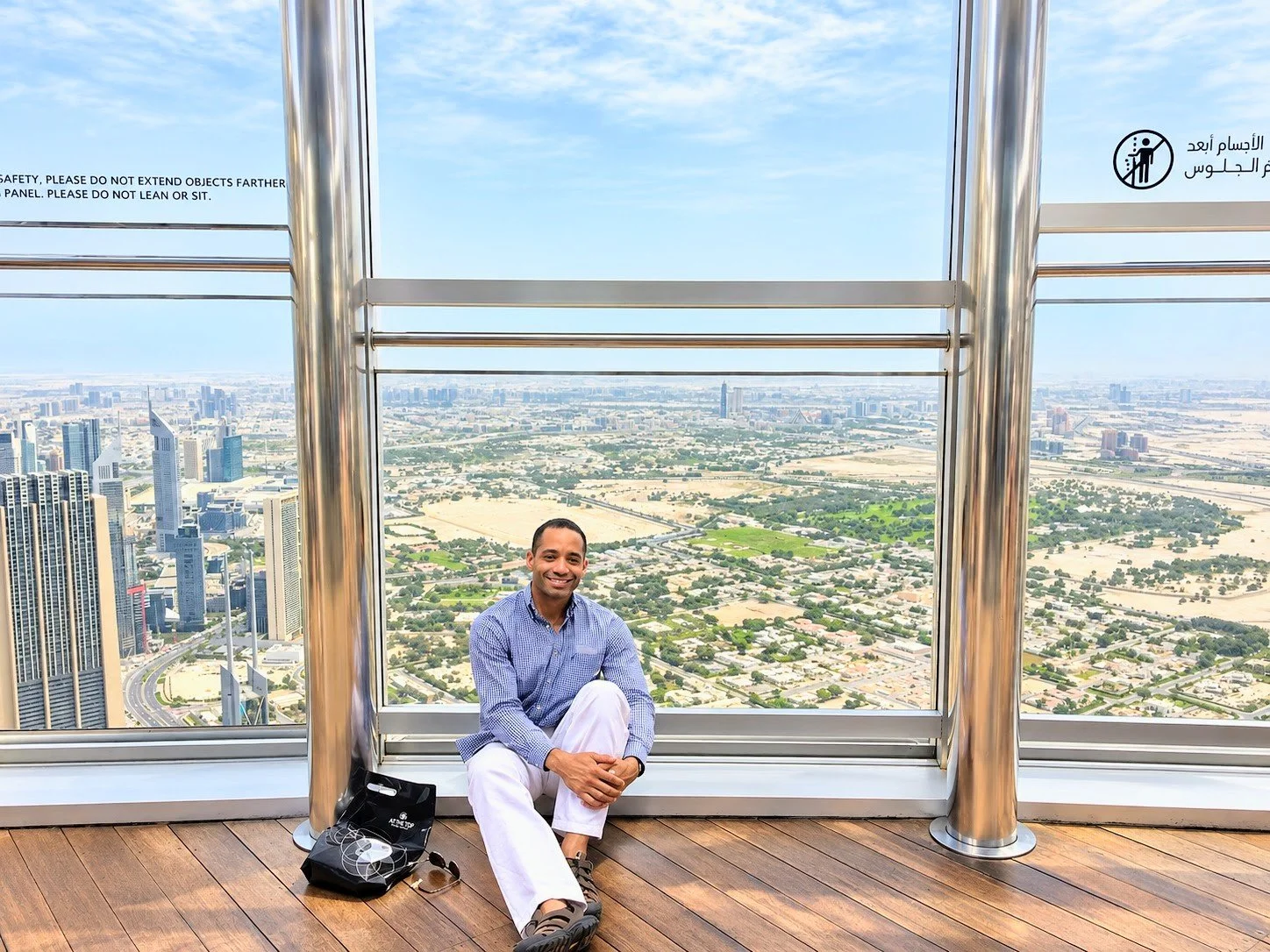
My perspective from the126th floor of the Burj Khalifa, Dubai, UAE
I remember listening to a story shared by a co-facilitator during a session that has stayed with me over the years. It was a simple story about her dropping her son off at school each day on her way to work, their morning commute, and a train. But behind that ordinary experience was an extraordinary lesson about perspective. Every morning, she followed a familiar routine. She would get herself ready for work, help her young son prepare for school, and head out the door with just enough time to get him to school and herself to work. Along their route was a railroad crossing.
She knew the train's schedule almost as well as she knew her own. Like clockwork, the train would pass through the crossing at approximately the same time every morning. As long as she left home on schedule, they could cross the tracks before the train arrived, allowing both of them to reach their destinations on time. It was a routine she had mastered. Until one particular morning.
For whatever reason, things were not going as planned. Perhaps getting ready had taken a little longer than usual. Maybe there had been an unexpected delay getting out the door. Whatever the reason, they were running behind schedule. As she approached the railroad crossing, she saw something she had hoped to avoid. The red warning lights began flashing. The crossing bells started ringing. And slowly, the railroad crossing arms began to lower. She knew immediately what that meant. They were not going to make it.
As the train approached, she felt her mood change. Frustration began to build. She was irritated with herself for not leaving earlier. She started thinking about her son being late for school, her own arrival at work, and how this unexpected delay would affect the rest of her morning. What had started as a perfectly ordinary day suddenly felt like a bad one.
And then, from the seat beside her, came a voice filled with excitement. "Look, Mom! A TRAIN!" Her young son was thrilled! His eyes lit up as he watched the enormous locomotive approach. To him, this was something special. He could see the train up close, hear its powerful engine, and watch the seemingly endless line of railcars roll past. What an unexpected treat! While his mother sat frustrated behind the steering wheel, her son was experiencing a moment of pure joy. And that is what makes this story so powerful.
They were sitting in the same car, at the same railroad crossing, watching the same train, at exactly the same moment. Yet they were having two completely different experiences. The mother saw an inconvenience. The son saw an adventure. The mother saw lost time. The son saw an unexpected opportunity. The mother was focused on what the train was preventing her from doing. The son was focused on what the train was allowing him to experience. Same train. Same moment. Different perspective.
I have thought about that story many times because it illustrates something we all experience in life. Two people can encounter the exact same situation and walk away with completely different feelings about it. Why? Because we do not simply experience life as it happens. We experience life through the lens of our expectations, responsibilities, experiences, and attitudes. The mother was not wrong to be concerned about being late. She had responsibilities, commitments, and people depending on her. And her son was not wrong to be excited. He was simply experiencing the moment without the burden of those adult concerns.
I have often thought about how two people working for the same organization, committed to the same mission, and wanting the same successful outcome can see things so differently. One sits in an executive office, making decisions that shape the future of the company. The other works on the front line, navigating the daily realities of those decisions.
Both have important responsibilities. Both contribute to the organization's success. Yet the distance between their perspectives can sometimes feel enormous. Why is that? I do not believe most executive leaders intentionally lose touch with their employees. In fact, many genuinely care about the people they lead. But as responsibilities increase, priorities shift, and layers of management grow, something can happen almost without anyone noticing. Leaders begin seeing the organization primarily through reports, financial results, strategic objectives, and performance dashboards rather than through the experiences of the people doing the work.
And that is where the disconnect begins. There is an old expression about seeing the world from 30,000 feet. From that altitude, you can appreciate the bigger picture. You can see patterns, connections, and possibilities that are not always visible from the ground. Executive leadership requires that kind of perspective. Leaders must consider financial performance, long-term sustainability, competition, customer expectations, and the future direction of the organization.
But there is something important to remember. You can see the entire landscape from 30,000 feet and still miss the potholes in the road. Those potholes are what frontline employees encounter every day. They are the inefficient processes, outdated equipment, staffing shortages, competing priorities, unexpected customer demands, and countless small obstacles that never seem to make their way into an executive presentation. A decision that appears perfectly reasonable in a boardroom may create significant challenges for the employees responsible for carrying it out.
For example, an executive may celebrate a reduction in operating expenses as a major organizational accomplishment. Meanwhile, the employees affected by that decision may be struggling to maintain service levels with fewer resources and increasing workloads. The numbers may tell a story of improved efficiency, while the people tell a story of growing exhaustion. Both stories deserve to be heard.
One of the realities of large organizations is that information does not always travel upward as accurately as it travels downward. Expectations, objectives, and directives often move quickly from executive leadership through the management structure to frontline employees. But concerns, frustrations, and operational realities do not always make the return trip with the same clarity.
Why? Sometimes managers hesitate to share bad news. Sometimes information is softened to avoid appearing negative. Other times, legitimate concerns become condensed into a few bullet points on a presentation slide. By the time the message reaches executive leadership, the urgency and human impact may have disappeared. And sometimes employees simply stop speaking up because they have concluded that nobody is really listening. That is a dangerous place for any organization to find itself.
I have always believed there's tremendous value in leaders spending time with the people who actually perform the work. But meaningful engagement requires more than an occasional facility tour, employee appreciation event, or carefully scheduled town hall. It requires genuine curiosity. What frustrates employees? Which processes make their jobs unnecessarily difficult? What resources are missing? Which executive decisions have created unintended consequences? What would they change if someone gave them the opportunity? And perhaps most importantly, are we prepared to hear the answers without immediately becoming defensive?
One of the most powerful questions an executive could ask a frontline employee is: "What are we doing at the leadership level that makes your job harder than it needs to be?" Imagine the conversations that question could generate if employees truly believed they could answer honestly. Imagine the improvements that might follow if leaders listened with the intention of understanding rather than explaining. Sometimes the greatest organizational insights do not come from consultants, executive retreats, or strategic planning sessions. Sometimes they come from the person who has been doing the job every day and has been quietly thinking, "There has to be a better way."
I also think it is important to recognize that executives and frontline employees do not have to see everything the same way. Their responsibilities are different, and naturally, their perspectives will be different. Neither group has the luxury of seeing every issue from every angle. And neither perspective should automatically be considered more valuable than the other. The goal should not be to eliminate those differences. The goal should be to bridge them. That mutual understanding builds something every successful organization needs: trust.
As I have progressed through my own leadership journey, I have come to appreciate that one of the greatest responsibilities of a leader is to remain connected to the people doing the work. It is easy to become consumed by meetings, reports, deadlines, and organizational objectives. Those things matter. They are part of the responsibility that comes with leadership. But people matter, too. And if we are not careful, we can become so focused on managing the business that we lose sight of the individuals who make the business possible.
I believe leadership requires us to continually challenge our own assumptions, seek perspectives different from our own, and remember that the people closest to the work often possess insights that cannot be found anywhere else. The higher we climb, the more important it becomes to remain grounded. Not because frontline employees always have the answers, but because their experiences are an essential part of finding them.
There is a difference between having a higher position and having a better perspective. A title may give someone greater authority, broader responsibility, and more influence over organizational decisions. But it does not automatically give them a complete understanding of what others experience. And perhaps that is one of the most important lessons in leadership.
The view from the top may show us where the organization needs to go, but the view from the front line helps us understand what it will take to get there. The best leaders recognize the value of both. They do not simply expect employees to understand executive decisions. They make a sincere effort to understand how those decisions affect employees. They do not interpret questions as resistance or concerns as negativity. They recognize that different perspectives can reveal blind spots, prevent mistakes, and lead to better outcomes. Most importantly, they never allow their position to create so much distance that they forget what it feels like to be the person carrying out the plan. Because at the end of the day, great leadership is not just about making decisions from the top.
It is about making sure the voices from the front line are heard before those decisions are made. Here is something worth thinking about: If the people on the front line could speak openly and without fear, would the picture they paint of your organization look the same as the one being presented in the executive boardroom?
And if not, which picture would you be willing to believe?
Until next time, keep learning, keep listening, and never stop looking at life from someone else's perspective.
Take care of yourself and each other!
— Chip
Chit Chat with Chip — Conversations about life, leadership, and the lessons we learn along the way.
