Simon
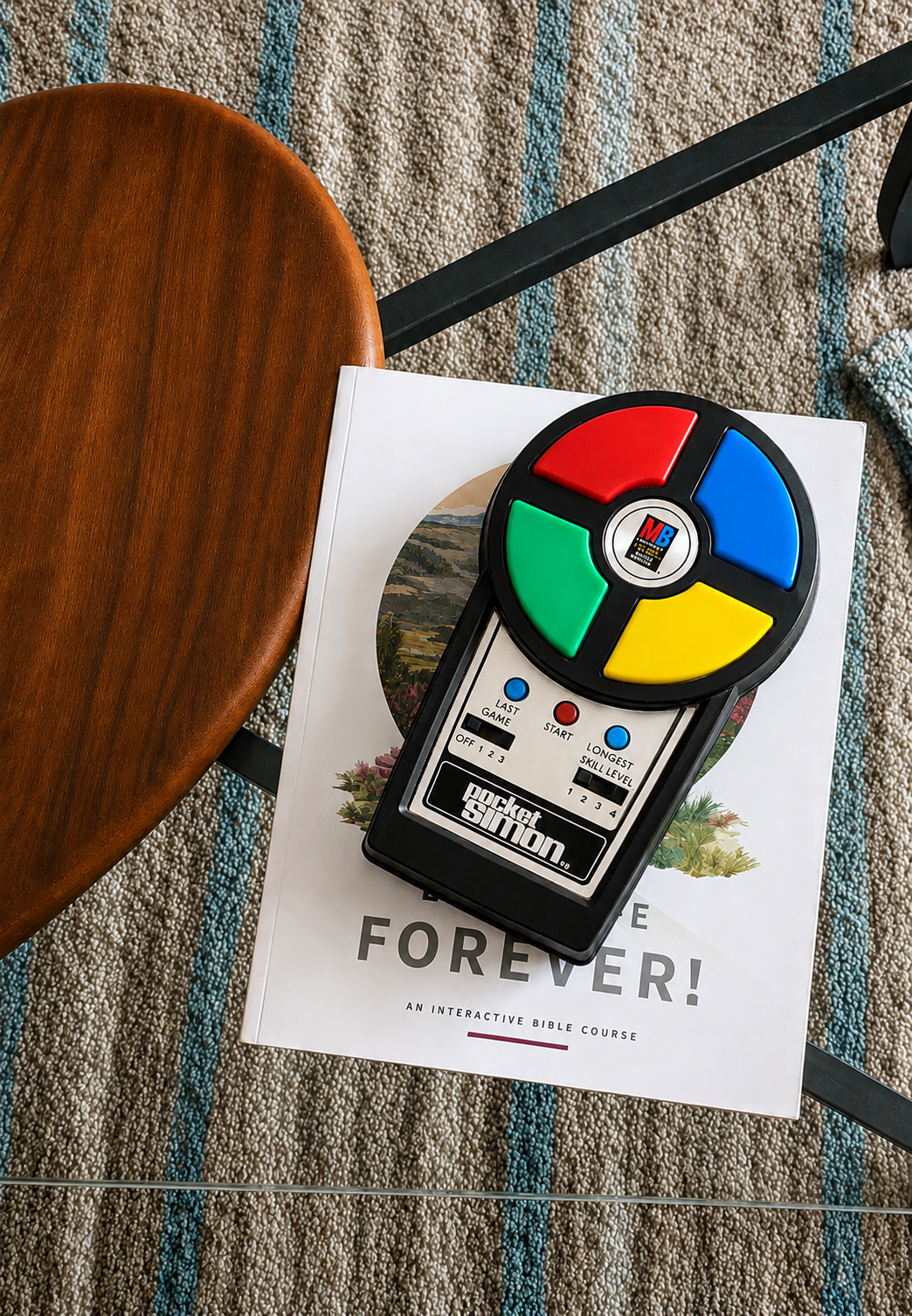
My Pocket Simon (Circa 1979)
With one of my very first paychecks I received from my grass cutting job as a teenager, I bought this Pocket Simon game. If you do not know, this electronic version of Simon Says (commonly called Simon) is a memory game rather than the traditional playground game. Instead of listening for the words "Simon says," players must watch, remember, and repeat an increasingly long sequence of lights and sounds. The goal is to correctly remember and repeat the longest sequence possible. As the game progresses, the sequences become longer and the pace often increases, making concentration and working memory more challenging.
I have had this game over 40 years and although it is marketed as a game, Simon exercises several important cognitive skills:
Working memory – holding and manipulating information briefly.
Selective attention – focusing despite distractions.
Processing speed – responding accurately as the pace increases.
Pattern recognition – identifying and remembering sequences.
Impulse control – resisting the urge to press a button before recalling the entire pattern.
These mental skills are why Simon has remained popular for decades and is often used as an example of a simple activity that strengthens memory and concentration.
The electronic Simon can serve as a useful metaphor for many aspects of real life.
The game is simple: observe, remember, and respond correctly. Life often works the same way, except the "sequence" is made up of experiences, lessons, relationships, and decisions rather than colored lights.
Here are a few parallels:
Life builds on previous experiences. Just as Simon adds one new step to the sequence each round, life continually adds new responsibilities to what you have already learned. Success often depends on remembering and applying past lessons.
Attention matters. Looking away from the game for just a moment can cause you to miss the next color. Likewise, distractions in life can cause us to overlook important opportunities, warning signs, or the needs of those around us.
Small mistakes have consequences. In Simon, one incorrect button ends the round. In life, not every mistake has such immediate consequences, but repeated poor choices or ignoring important signals can have lasting effects. Fortunately, unlike Simon, life usually gives us opportunities to learn, recover, and try again.
Mental overload is real. As the sequence grows longer, remembering everything becomes harder. Similarly, work, family, finances, and personal commitments can overwhelm our mental capacity if we do not develop healthy ways to organize, prioritize, and rest.
Practice improves performance. No one is born able to remember a 30-step Simon sequence. The brain adapts through repetition. The same is true for leadership, communication, emotional intelligence, and resilience—skills improve with consistent practice.
One difference is especially important: the electronic game demands obedience, while real life demands discernment. In Simon, your only job is to repeat the pattern exactly. In life, blindly following every voice, trend, or authority is not always wise. We must decide which "voices" deserve our attention, and which should be ignored.
That distinction also connects to emotional intelligence. Throughout childhood and adulthood, we are constantly exposed to "signals" from parents, teachers, employers, social media, friends, and culture. Some of those messages help us grow; others can shape unhealthy beliefs if we accept them uncritically. Emotionally mature people learn to recognize those influences, evaluate them, and choose responses that align with their values rather than simply reacting.
This makes Simon a fitting illustration for a broader life lesson: pay attention, remember what truly matters, and respond thoughtfully rather than automatically. Those who cultivate awareness, reflection, and good judgment are often better equipped to navigate life's increasingly complex "sequences." I often thought I would graduate from the solo player Pocket Simon to the larger multiplayer family Simon. That never happened with the game or in life.
Life will always have a "Simon." The voices around us will never stop giving directions. The challenge is not eliminating those voices but deciding which ones deserve our attention.
In the end, perhaps the most important question is not, "What does Simon say?" It is "Who gets to be Simon in my life?"
Take care of yourself and each other!
